
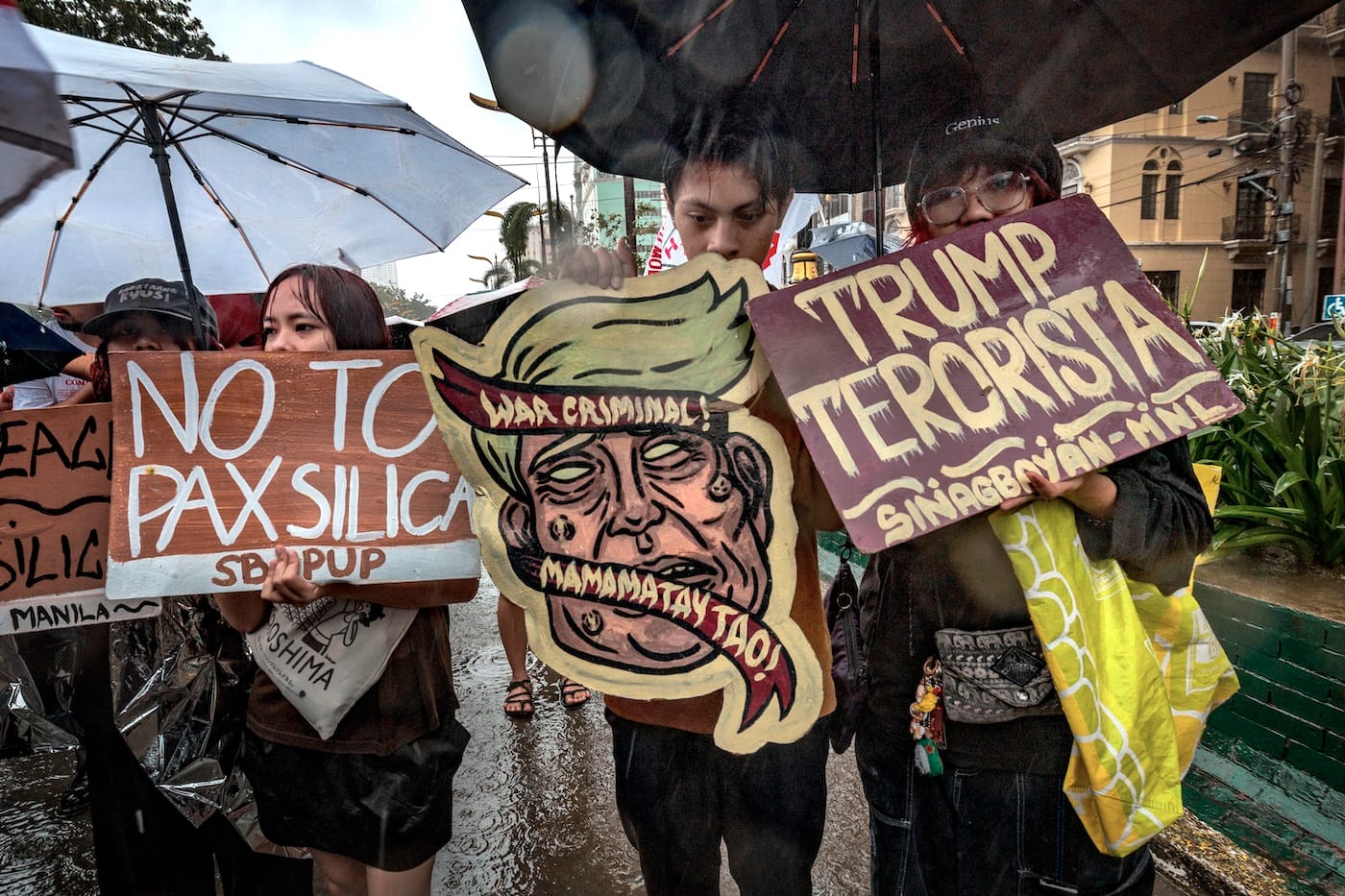
The US and nine allies signed an agreement to secure the global AI supply chain against China, as tens of thousands in the Philippines hold protests against the alliance over a proposed manufacturing and data hub that's about the size of 3,000 football fields.
The agreement, called the San Francisco Declaration on the Secure Foundations of Enduring Prosperity, comes amid growing concern in Washington over China's efforts to gain access to advanced AI technology, including Nvidia's high-end semiconductor accelerators, as Bloomberg reports.
Recent revelations that Nvidia CEO Jensen Huang had been targeted by Chinese intelligence have added to the scrutiny surrounding the company's technology and its potential transfer to China, as SFist reported last week. President Donald Trump is also expected to meet Chinese leader Xi Jinping in Shenzhen later this week, with the future of AI and technology trade among the issues facing the two governments.
According to Bloomberg, the declaration was signed at a San Francisco retreat convened by US Under Secretary of State for Economic Affairs Jacob Helberg. Along with the US, the nine signatories are Australia, India, Israel, Japan, South Korea, Qatar, Singapore, the United Arab Emirates, and the United Kingdom. Germany, the Netherlands, and Sweden are also expected to sign in the coming days.
The agreement identifies two broad categories of assets the participating governments intend to protect. The first covers sensitive technologies, including software, materials, components, and the knowledge and manufacturing capabilities needed to produce them, particularly those that could provide hostile actors with a military or intelligence advantage. The second covers critical infrastructure, including ports, transportation and logistics networks, communications systems, energy infrastructure, and the digital platforms connecting them.
Participating governments plan to establish five joint working groups covering innovation policy, AI adoption across key industries, supply chain cooperation, security hubs, and AI resilience. They also committed to coordinating efforts against economic coercion and supply chain disruptions while reducing reliance on potentially vulnerable suppliers.
The declaration is part of Pax Silica, a US-led initiative launched last December to build a network of trusted partners capable of securing the global AI supply chain. The effort encompasses everything from critical minerals and energy production to semiconductor manufacturing, advanced computing, data centers, and the infrastructure needed to connect them.
But the push to build out that infrastructure is already encountering resistance in the Bay Area, where several cities are reconsidering whether they have the resources to accommodate the industry's growing demands. As previously reported, San Francisco and Oakland approved temporary moratoriums on new data center development in October, while Oakland has since extended its pause through October 2027. San Francisco is also considering a longer extension, and San Jose officials have proposed a temporary halt until stricter rules are in place, as the city faces 11 pending data center applications.
A November 10 report commissioned by the San Francisco Planning Department warned that a 50-megawatt data center could consume as much electricity as 25,000 homes, as the Chronicle reported last week. The city's transmission capacity is already approaching its limits, raising concerns that large facilities could compete with housing, hospitals, and businesses for electricity. The report also flagged potential noise and air pollution from backup generators, particularly in neighborhoods already dealing with environmental burdens.
The New York Times reports that in the Philippines, where the government has agreed to develop a major industrial hub as part of Pax Silica, more than 70 organizations have formed the Network Opposed to Pax Silica. Farmers, students, and activists say the project could strain already limited water and electricity supplies and displace hundreds of Indigenous Ayta people.
The proposed development in New Clark City, about two hours from Manila, is expected to cover an area roughly equivalent to 3,000 football fields. Government estimates put its potential water consumption at up to 90 million liters per day and its electricity needs at 3 gigawatts, roughly one-fifth of the country's total electricity consumption in 2024. The government says the project could generate $3 billion in annual revenue and create as many as 190,000 jobs.
There is also some inconsistency over what the development will actually contain. Philippine officials have described it as a semiconductor manufacturing hub, while the State Department has said the inclusion of data centers will depend on future environmental and infrastructure studies.
The opposition has extended to the Bay Area, where Filipino community organizations and allies held an October gathering at San Francisco's Jones Memorial Church calling for an end to Pax Silica's planned developments in the Philippines. Organizers cited environmental destruction, Indigenous displacement, and exploitation among their concerns.
As Democracy Now reports, the San Francisco agreement was signed as world leaders gathered in Antalya, Turkey, for COP31, the annual United Nations climate summit held under the framework of the 2015 Paris Agreement. The United States, which President Donald Trump withdrew from the agreement for a second time, sent no official delegation.
Outside the summit, more than 10,000 people reportedly took part in a climate march on Saturday, demanding faster action on global warming and a transition away from fossil fuels. Protesters also criticized governments for continuing to support polluting industries while failing to protect communities bearing the brunt of environmental damage.
Related: Report: Leading Chinese AI Models Were Trained on Nvidia Chips China Wasn't Supposed to Have


