
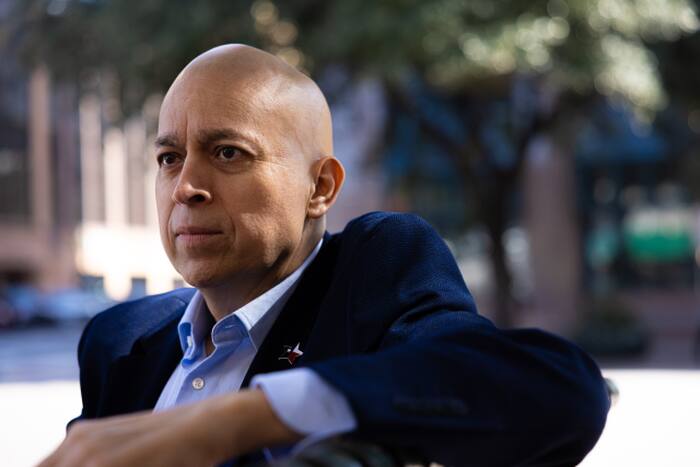
Benjamin Flores has heard the jokes: the ones that say he woke up the morning after the election, flabbergasted to learn he had been elected Texas’ new land commissioner, overseeing the state’s oldest agency and its $1 billion annual budget.
It’s not true, of course. Flores watched the election results roll in the night of Nov. 3 with his small but mighty campaign team in Houston. When his win was announced, he went outside with his wife and cried, overwhelmed by the trust voters had put in him.
But he gets it. Most voters don’t even know the General Land Office exists, let alone the name of the Democratic nominee who was outfundraised 47 to 1 and spent the home stretch of the campaign in a hospital bed, recovering from cancer treatment.
“I’m not naive,” he said. “People were pissed off, and we just happened to be standing there.”
Flores, who unseated Republican Dawn Buckingham, is the first Democrat to win the office since 1994, part of a Democratic sweep of every statewide race on the ballot. Neither land commissioner candidate broke through with voters: An October poll from the University of Houston found 78% didn’t know enough about Flores to have an opinion of him, and 73% said the same about Buckingham.
But now that he’s won, Flores intends to take the job seriously, he said, starting by introducing himself to Texans who likely saw his name for the first time in the voting booth. He’s meeting with GLO staff, reassuring them that he has no intention of taking a wrecking ball to their ongoing work, and learning the intricacies of a state government he has never worked inside.
He says he wants to run the GLO as the most apolitical of the state agencies. Most of what it does is bureaucratic: protecting state lands, administering disaster relief and running veteran and school funding programs.
But in recent years, leadership has ensnared the agency in hot-button battles about how Texas’ story should be told at the Alamo, which it oversees, and it has faced lawsuits and federal investigations into the distribution of aid after Hurricane Harvey. Buckingham vowed to make state lands available to the federal government for deportation facilities and assisted with state efforts to build a wall along the U.S.-Mexico border — though she has pushed back on plans to put barriers in the Big Bend region.
Flores agrees with keeping border barriers out of Big Bend, but said he opposes some of the other political stances agency leadership has taken, especially when it comes to the Alamo.
Former Land Commissioner Jerry Patterson, a Republican, said he admired Flores’ instinct to keep the agency out of partisan battles, but the reality of serving in an elected role makes that difficult.
“If you’re doing a good job and want to keep doing a good job, you gotta play the politics game,” Patterson said. “The land office is esoteric policy and nobody cares about the esoteric policy questions, so you have to talk about other stuff.”
Now, the agency will be run by a Mexican immigrant with a background in cybersecurity and pig farming, whose government experience is limited to serving on the Bay City council. He ran, he said, because Texas’ elected officials spend too much time on petty things that don’t matter, while dropping the ball on the big stuff that affects people’s lives.
“For being the small government party, they really were going around telling everybody what to do,” he said. “It’s every single time, every single session, and I just felt, someone needs to do something about this. This needs to stop.”
Flores immigrated to the United States in 1996, drawn by the idea that in America, you can start with nothing and make yourself into a success.
“Of course, I never imagined that 30 years later, I’d be holding statewide office in the second-largest state in the country,” he said.
He settled in San Diego, where he met his wife, An, and began working in cybersecurity. They moved to the Bay Area and had a daughter, and eventually decided to follow others who were coming to Texas in droves.
“Texas was seen as like the Land of Oz or something, but then you move here and start discovering that not everything is perfect,” he said. They weathered Hurricane Harvey and Winter Storm Uri. After a stint working as a contractor for Travis County — under then-County Judge Sarah Eckhardt, now the comptroller-elect — Flores vowed to never work for the government again.
Instead, when COVID hit, he and his wife decided to get into another field entirely: pig farming. They bought 10 acres in Bay City, 90 minutes southwest of Houston, with a big pecan grove they planned to use to fatten up swine to eventually sell for high-end charcuterie. They named the ranch Lord of the Pigs.
Flores already had seven pigs on the property when he learned the city had a no-pigs ordinance. He went to the City Council to request an exception, and when he brought his young daughter up to the microphone to speak, he said, a member of the council cut her off.
He was angry, as much about the rudeness as the denied variance, he said. When that member’s seat came open, he ran and won.
“A lot of people think I ran because of the pigs, but it was much more than that,” he said.
Flores was able to continue his pig operation after the Legislature voted to kneecap cities that wanted to restrict farming operations. But the pig drama continued: His neighbors sued, and the city undertook environmental testing. The “Great Pig War of Matagorda County,” as Texas Monthly termed it, is still playing out in the courts.
In the meantime, Flores set his sights beyond the Bay City council. He first threw his hat in for governor, outraged by three-term incumbent Gov. Greg Abbott’s focus on culture war issues and limiting local power.
“But then I had some folks reach out to me, telling me to take a look at the [General Land Office],” he said. “It has a lot of power. I’d be overseeing benefits for veterans, public school funding, disaster recovery, and that was a big sell, as someone who lives by the coast.”
Unlike most of the other statewide candidates, he had no experience in the Legislature or working in state government. He had no political networks, no experience fundraising.
“I was just some guy with a dream, and a supportive wife,” he said.
Down-ballot races like this one rarely attract much money or media coverage, but this one was particularly quiet. Flores raised just $80,000. His largest single donation was $10,000 from U.S. Senate candidate James Talarico, and another $16,000 was pro bono campaign consulting services.
Buckingham brought in $3.75 million since the beginning of 2025, and spent modestly on ads touting herself as the first female land commissioner in Texas history.
Campaigning for a little-known state office with no name recognition and no money was exhausting. Flores kept getting sick and was frequently winded from going up stairs. He chalked it up to too many hands shaken and babies kissed until he ended up in the emergency room on a Friday afternoon.
Turns out, it wasn’t the campaigning. It was cancer.
Flores was diagnosed with leukemia in April, and immediately, his politicking ground to a halt. The modicum of support he’d built up evaporated, he said, as everyone assumed he wasn’t long for the campaign.
On stage at the Texas Democratic Party convention in Corpus Christi in June, Flores lifted his cowboy hat to reveal his mostly bald head and shared that chemotherapy had put the cancer into remission.
But his recovery wasn’t over. In September, two months before the election, he had to have a stem cell transplant, an intensely invasive process that required him to stay in the hospital for a month to recover. While other candidates were barnstorming the state in the home stretch of the election, Flores was stuck in a hospital bed, down 40 pounds, watching his hair fall out.
He never considered dropping out of the race, he said. His wife had put her own life on hold to support his political dreams and carry him through cancer, and he said he owed it to her to see the race through.
Flores is still in recovery. He’s technically supposed to remain within 30 minutes of MD Anderson for the first 100 days after his transplant, in case of complications, but he’s been up in Austin, meeting with GLO staff and getting ready to take on running a billion-dollar-a-year agency.
“My idea has always been others before self,” he said. “There’s too much going on to wait. Session’s going to start, budget time is here … we’ve got all kinds of Texans to help.”
Flores isn’t the first outsider to win the land commissioner job. The Republican who flipped the agency in 1998 was also a businessman with no experience in state politics: David Dewhurst, who parlayed the role into 12 years as lieutenant governor, becoming an influential GOP player.
After Dewhurst, Patterson and George P. Bush also tried to climb beyond the GLO, and Buckingham’s name has long been thrown around for higher office. While much of the land commissioner’s work is too wonky to describe in a campaign ad, there’s one responsibility they have reliably tried to hang their hat on: the Alamo.
In the vast portfolio of GLO responsibilities, the Alamo is a small-dollar item, a little more than 1% of the current two-year budget. But the 300-year-old Spanish mission, and the story behind it, has become the site of a high-stakes but ultimately futile battle for land commissioners hoping to enshrine their names in history.
When Bush took office in 2015, he launched a $450 million renovation project, promising to restore the crumbling historic site to its proper glory. What would have seemed at the outset to be a noble mission that all Texans could get behind ended up becoming a quagmire of vicious political infighting that rages to this day.
The first battle was over Bush’s plan to repair the Cenotaph, a monument to the fighters who died at the Alamo, and move it 500 feet south to a more historically accurate location. Conservative groups and Lt. Gov. Dan Patrick objected, claiming it was an attempt to diminish the importance of the battle. The Texas Historical Commission ultimately blocked the move.
As those little sparks grew into a conflagration online, conservative groups spread rumors that Bush planned to build a monument to the Mexican general Santa Anna outside the Alamo. Bush, whose mother is Mexican, called the accusations “flat-out racist.”
Part of the renovation project involved building a new museum to document the site’s history, which kicked off a larger fight over how exactly Texas should remember the Alamo.
Historically, the story centered on the 200 men who waged the final, 13-day battle. But some felt it was time to confront a more complex narrative that took into account the site’s history as a Native American burial ground and the role that slavery played in motivating the fight for an independent Texas.
The fight over the story of the Alamo became a symbolic flashpoint as Texas conservatives turned against critical race theory and diversity, equity and inclusion efforts. When Buckingham ran for land commissioner in 2022, she promised “no reimagining the Alamo” and vowed to stop “radical revisionists” from rewriting the state’s history.
She held true to that, kicking off a firestorm last year when the Alamo’s social media account posted a celebration of Indigenous Peoples’ Day. Buckingham condemned the post, saying “woke has no place at the Alamo.”
Two days later, Patrick piled on, demanding the resignation of Kate Rogers, CEO of the Alamo Trust, over views she expressed in a doctoral dissertation she wrote while working at the site. She wrote that while she hoped the Alamo would “become a beacon for historical reconciliation … politically that may not be possible at this time.”
Rogers resigned and then sued, saying that while the “fighters at the Alamo courageously held off Santa Anna’s troops for thirteen days,” Patrick and Buckingham “only needed eleven days to lay siege to the First Amendment.” That lawsuit is ongoing.
This is the hornet’s nest Flores now inherits, at least temporarily. As the renovation project careens toward the finish line, so does the GLO’s control of the Alamo. The Legislature voted last year to transfer ownership to a commission made up of the governor, lieutenant governor, House speaker and two lawmakers, a process that’s expected to start in 2027 and be completed by the following year.
Flores said Wednesday that he needs to get up to speed on the intricacies of the project, but his first instinct is that oversight should stay with the GLO to avoid muddling the project further.
“My official stance is, nothing makes a situation better than throwing more politicians at it,” he said sardonically.
He hasn’t talked to Rogers, but thought the decision to fire her was “mind-boggling.” He hopes to start by getting the right people in leadership positions and letting them manage the project.
These are the kind of tribal squabbles he felt Texas’ Republican leaders were too consumed by, a frustration that pushed him to run for statewide office. When he thinks about the big tasks that await him, from managing disaster recovery to overseeing the Permanent School Fund and veterans’ issues, he said it’s hard to imagine spending too much time worrying about a social media post from one historic site.
“I personally don’t have time to do shit like that,” he said.
Disclosure: Texas Monthly has been a major financial supporter of The Texas Tribune. University of Houston has been a financial supporter within the past five years. The Texas Tribune is a nonprofit, nonpartisan news organization that is funded in part by donations from members, foundations and corporate sponsors. Financial supporters play no role in our journalism. Find a complete list of them and more information about our financial and disclosure policies here.


